Civilian Conservation Corps Company 2359

President Franklin D. Roosevelt made a deal with three million young men in 1933. He would pay them $30 monthly, plus room and board, to improve public lands, forests, parks, and respond to other environmental and infrastructure projects in the United States and its territories. The president enacted the deal by executive order. It put forth a “New Deal” to preserve the future of the American landscape and engage the young, unemployed American male of the Great Depression. The families of men in Company 2359 received $25 monthly. The remaining $5 went to the men. Additional benefits included educational and vocational opportunities. Men without high school diplomas could study and get one. The work programs in the field and in the camps were rigorous and well organized to ensure improvements in the men and in the country. “New Deal” programs however, were discontinued in 1942 as World War II swept the globe and captured many Civil Conservation Corps workers in its wake.

Company 2359 was established near Mineral, VA in 1934. Its newsletter, Camp High Lights, demonstrates the organization and comradery typical of this and other camps throughout the United States. Notable in the June 1, 1937 edition (13 pages) is a listing of camp officials, technical staff, foremen and camp faculty. Then came editorials, an advice column, camp news including a visit by local officials, personal accomplishments, project reports, sports, history of Louisa County with a map, ‘Phoolishness’ (their spelling), a sketch of Joan Crawford and cartoons; all of this in one newsletter.

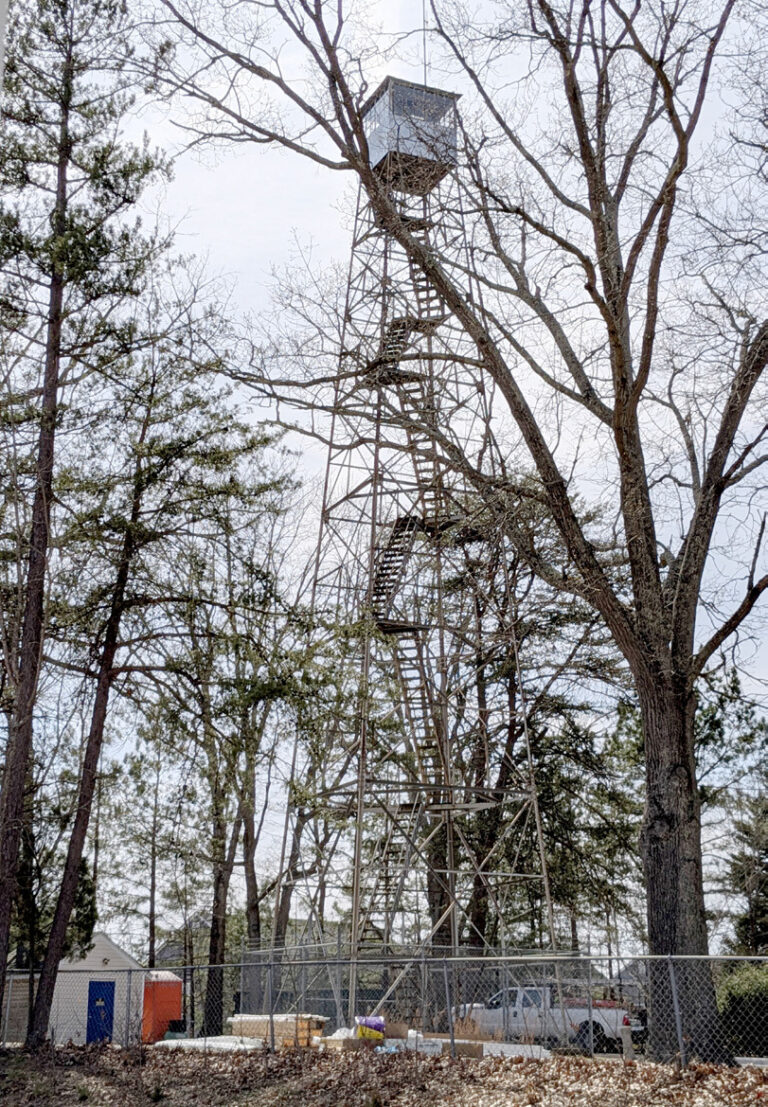
Young men working at Company 2359 were responsible for clearing woodland trails, improving public roads and fighting forest fires. They build the fire tower on Route 33 that rises to a height of 102 feet. It is described in the National Historic Lookout Register as an “Aermotor tower with a 7’ x 7’ steel cab.” The structure is located on the grounds of the Virginia Department of Forestry in Louisa and is maintained for emergency use only. It is not open to the public.

Franklin D. Roosevelt famously said: “the only thing we have to fear is fear itself.” One can hardly imagine life without fear in the depths of the Great Depression (1929-1939). Unemployment was 25%, banks were failing, the stock market crashed and widespread drought in the mid-west Dust Bowl ruined agriculture, causing farm foreclosures and mass migration out of the region. The government under President Roosevelt had to do something quickly with massive implications and widespread effects. Enter the “New Deal” and Secretary of Labor, Frances Perkins. She had previously served as Commissioner of Labor with Roosevelt when he was governor of New York and now became the first woman to serve as a cabinet secretary in the U.S. government. Both the Secretary and the President believed in work-relief programs, having successfully established one previously in the state of New York. They both knew that such a program was now needed on a much larger scale, and needed quickly. They set about organizing and implementing plans for the Civil Conservation Corps, which proved to be the most popular of President Roosevelt’s New Deal programs. The first camp to open in 1933 was in Luray, VA, adjacent to the George Washington National Forest.

Heunemann, Ronald. “Civilian Conservation Corps” Encyclopedia Virginia, Virginia Humanities, (07 Dec. 2020). Web. 29 Mar. 2026.