American history told through local lens

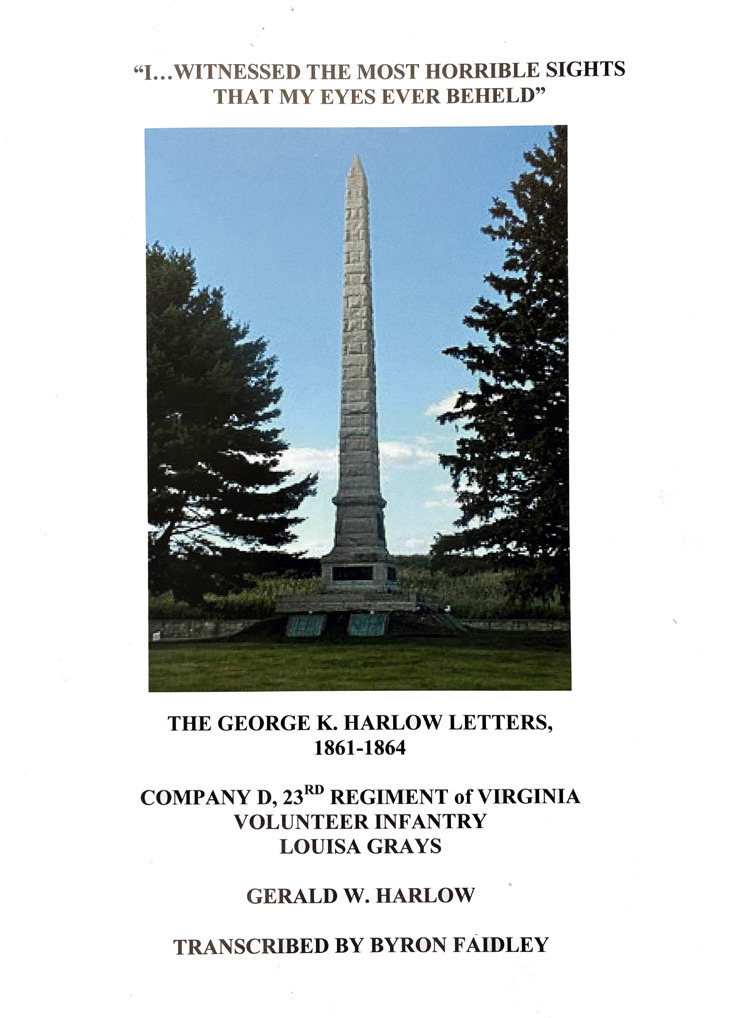
While at the camp of the 23rd Virginia Regiment in June of 1863 in Sharpsburg, Maryland, Confederate soldier George K. Harlow writes home to his Louisa family that he recently, “…witnessed the most horrible sights that my eyes ever beheld.”

In the letter, Harlow documents roughly nine months after the Battle of Antietam — what is considered the single deadliest single day battle in American history — that “dead yankeys” with little dirt thrown over them were being rooted out of the ground by hogs that began to eat them.

“Oh, what a horible sight for human beings to look upon in a sivilized Country, when will this horrid ware ever end; God grant the time may speedily come…,” Harlow writes.

This letter, among dozens of others from mid-1861 to mid-1864 during the American Civil War, are documented in “I…witnessed the most horrible sights that my eyes ever beheld: The George K. Harlow Letters.” The book was published by Louisa resident Gerald W. Harlow who started researching his family history in 1986.

The letters of George K. Harlow are held at the Virginia Museum of History and Culture. They were a gift in 1964 from Iris Harlow McMahon, who was a descendant of Harlow’s brother, Alexander “Sandy” Harlow.

“They are among many that have not seen the light of day for decades, perhaps even a century before being donated,” Gerald writes in the dedication.

For one letter, Harlow wrote home and his sister wrote back on the same paper. Others were damaged, some illegible. But Byron Faidley, Gerald’s friend, transcribed the letters while Gerald wrote an exposition at the beginning of each chapter capturing the context of what was happening during the Civil War.

History books document that Virginia seceded from the Union in April, 1861, but Gerald pushes back against this narrative. He documents in the foreword of the book that Virginia sent out a referendum to its citizens on whether to stay or secede and Virginia had already voted twice to stay. It wasn’t until newly-elected President Abrahm Lincoln called for 75,000 volunteers to invade the Southern states that had already left the Union did the referendum come back to Virginians.

“This book is dedicated to our ancestors and relatives who came forward when Virginia called her sons to defend her borders from an invading army, one bent on the destruction of their homes and land,” Gerald writes in the dedication. “For the revisionist historians who have convinced the world that these poor subsistence farms, mill workers, and laborers left their homes, wives, children and families to fight for another man’s slaves, you can never convince us of such false revisionist history.”

In May, 1861, Virginians voted on whether to secede or stay in the Union. Louisa voted 1,167 to 0 to secede. Gerald documents that his great-great grandfather Stephen L. Crew and his brother James V.M. Crew went to vote, and later that day joined 57 other western Louisans to join Company D, Louisa Grays, of the 23rd Virginia Volunteer Infantry. They enlisted under William James Sargeant who formed the company. Joining the 23rd would be two more companies from Louisa, two from Amelia, and one each from the counties of Goochland, Prince Edward, Charlotte, Halifax, and the City of Richmond.

On page 68 of the book, Gerald documents the 59 men who enlisted at Trevilian Station. 17 of the original 59 would die by the war’s end.

“It’s a who’s who of western Louisa County who came together,” Gerald said.

The first death of a man from the 23rd was Fendall C. Whitlock who died of disease before the first shot from the regiment rang out. They buried him on a hillside at Camp Laurel Hill outside Belington, Virginia.

“He was in an unmarked grave,” Gerald said. “I put a tombstone up there for him.”

The Harlow letters document the battles that the Louisa men fought and the difficult times they went through, but one of the “amazing” things is his concern with the farm back home, Gerald said.

“[He] writes back home, ‘you need to get the wheat in now, you need to do the corn crop.’ In the summertime, ‘you need to get the wheat cut now while it’s ready, you need to put the hogs up. Do not sell the cows; do not sell the hogs,’” Gerald said. “He manages the farm through the letters back home.”

Another concern was his youngest brother “Sandy.” Harlow went as far as to contact a lawyer in Louisa to make sure he didn’t enlist until he was 18.

There were prayers every night in the Confederate camps, Gerald documents, and Harlow led some of the preaching. He admits in his writings that he is not a very good preacher, but leads prayers and revivals once a week.

Harlow, along with 150 of the 300 members of the 23rd Virginia Infantry Regiment, was captured at Spotsylvania Courthouse. He would die of disease caused by starvation and lack of medical attention at Pea Patch Island in Delaware. Today, Harlow rests in a mass grave at Finns Point National Cemetery in New Jersey.

“Without reading these firsthand accounts, people have no clue what these men went through,” Gerald said.

Gerald believes that George K. Harlow, along with his brothers who also served, Thomas, Henry, and Alexander, are his first cousins five times removed. Another way to phrase it is they were likely first cousins to Gerald’s greatgreat grandfather, Williams James Harlow.

Gerald dedicates the book to the men of Louisa who served in the Confederate army. But of all his discoveries, he said the greatest is General Robert E. Lee being a second cousin five times removed on the Carter Family line. Lee’s mother was Anne Hill Carter Lee.

Faidley, Gerald’s friend from a Civil War reenactment unit, started transcribing the letters in 2009 and worked on them off and on over the course of the next several years. When he first started, Faidley said the Virginia Museum of History and Culture wouldn’t let him access the original letters, so he had to resort to working on microfilm copies.

Faidley noted that soldiers frequently had access to letter writing manuals and that throughout the Harlow letters, the reader can tell when he learns a new style of punctuation whether he is using commas or semicolons throughout his latest writing.

“There is a lot of great content in this particular set of letters…you get to this one last slip of paper and he has been captured and he is writing home,” Faidley said. “And then that’s it and you find out that he dies from disease a little while after that and never makes it back home. That really struck me, watching this last word that he has written home to his family, his parents, and brothers and sisters… it’s not like a memoir written after the fact or someone trying to recall something. These were written just after an engagement or sitting in camp — this is real time reporting, having someone put into words, what’s happening, how they are feeling during the war. To understand a conflict is complex and nuanced. Primary source documents, like letters written at the time, are probably one of the best things that anyone can read.”

Faidley encourages those who have their own historical letters from family to preserve them for future research.

“Primary source documents are so important,” Faidley said. “If anyone has any at home, reach out to local historical institutions or institutions of higher learning. Even if these are treasured family keepsakes — they are so important to the fabric of the history of this country. Get them scanned, get them preserved and make them available for researchers. It’s so important to further understand this terrible thing that happened 165 years ago.”

Copies of the book are available at the Louisa County Historical Society, as well as three other books that Gerald has published. These include the 1850-1868 roll book of Mechanicsville Baptist Church which includes the church membership of freed blacks, slaves, and the white church members, “I have bad news: Morris Family Letters, 1861-1865, Fluvanna/ Louisa Counties, Virginia,” and “Four Harlow Brothers of Louisa County, Virginia in World War II and Carter, Crew and Harlow Family Stories.”

“Today, those like our elected officials who have no ties to Virginia paint a false narrative and want to destroy the Virginia history of the War between the states, and they try to tar the image of these men who suffered for four years, and in the case of George K. Harlow, gave his life for Virginia,” Gerald said. “Men from Louisa have always stepped forward when called, and from the French and Indian War until today, many gave their lives for freedom as they saw the need to defend their homes and families…to quote “The Gray Ghost” Colonel John S. Mosby: ‘Virginia is my mother, God bless her! I can’t fight against my mother, can I?’”