Working the land

A longtime Louisa County farmer whose work bridges agriculture, engineering, and community service has been inducted into one of Virginia Tech’s highest departmental honors.

From tractor labs in Chicago to streambank restoration in the countryside, Fred F. Massie’s career started in the red clay and farm fields of Louisa County—where work, family, and service have always gone hand in hand and hard work is measured in seasons.

On April 30, 2026, the Department of Biological Systems Engineering at Virginia Tech inducted Massie into its Academy of Distinction, recognizing his lifetime of achievements within the industry.

Massie, a Class of 1978 Agricultural Engineering graduate, was honored for decades of work involving farm stewardship at The Massie Farm, contributions to engineering research and education, and long-standing service to his community in Louisa County.

He is the thirteenth inductee into the Academy of Distinction since its creation in 1995 on the occasion of the department’s 75th anniversary. The honor is reserved for alumni whose careers demonstrate exceptional professional achievement, leadership, and service consistent with Virginia Tech’s motto, Ut Prosim (That I May Serve).

“We are delighted to see Fred’s contributions and impact acknowledged with the highest honor we confer,” said Dwayne Edwards, department head. “With his induction into the Academy of Distinction, Fred takes his rightful place among a select group of alumni whose achievements and spirit of service will inspire students for many years to come.”

Despite decades of hard work evident in the callouses on his hands, Massie said he was surprised by the recognition.

“I looked at the other [12] people that were inducted ahead of me and most of them had Doctor in front of their name, and they were excellent engineers,” Massie stated. “Why they chose me, it’s still a surprise to me, but I think it was partly because I spent a good amount of time doing things [in the community] outside of the farm.”

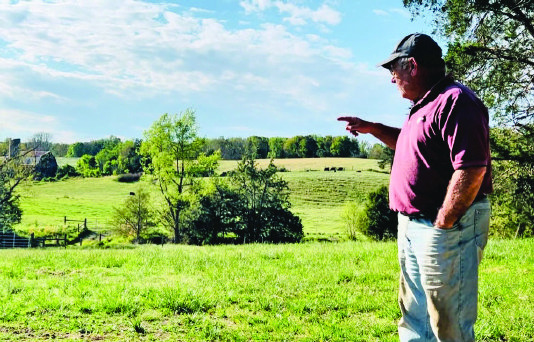
Massie’s selection highlights his conservation work at The Massie Farm, a fourthgeneration family farm in Louisa County that he has helped transform through rotational grazing practices and long-term environmental stewardship.

His efforts include protecting 33,000 feet of stream bank and establishing 75 acres of natural vegetation buffers across the York River Basin, initiatives that have improved water quality and wildlife habitat. The farm’s environmental work earned recognition with a Clean Water Award in 2024.

“You keep the cattle off of the stream bank so they are not walking up and down making a place for soil erosion to happen,” Massie stated, noting that the stream on his property ultimately feeds into Lake Anna. “Also, by having the vegetative cover there, you are intercepting any water that flows off of the surface of the ground and it will catch any pollution and acts as a filter before it gets in the stream…This 33,000 feet has protected Lake Anna tremendously.”

On the farm, Massie also installed a ballvalve livestock waterer that allows cattle to drink clean water from a well, reducing reliance on creek water and limiting sediment disturbance.

Massie was born at the Louisa County hospital in 1955 and graduated from Louisa County High School in 1973. His family’s agricultural roots in the region date back to 1926, when his grandfather purchased the farm, previously owned by the Woolfolks. During the Great Depression, the operation survived through small-scale production methods, including a stationary hay baler and hand labor.

“On a good day you could bail 40 tons, and each person that was helping got .5 cents a ton,” Massie stated. “General farm pay was a $1 a day, so the people were very much incentivized to work hard for more money.”

Massie began working alongside his father at the age of four and eventually assumed full management of the farm following his father’s passing in 1997. In 2016, his son Peter returned from the Marine Corps and joined the operation as a full-time partner.

Massie’s engineering background includes cooperative education work with International Harvester in Chicago, Illinois, where he worked in tractor laboratories involving the 86 series and troubleshooting the 66 series.

After a brief period in graduate school, he returned to Louisa County to pursue full-time farming.

He also contributed to the Virginia Tech Agricultural Engineering Department as a laboratory teaching assistant and research support staff member, where he helped improve the accuracy of solar collector flow measurements.

Beyond agriculture and engineering, Massie’s service has been deeply rooted in his local community. He has held numerous leadership roles at Louisa Baptist Church and has led youth construction teams as crew chief for Impact Virginia summer projects.

Massie emphasized that communication and attentiveness remain central to both farming and community life. Despite decades in agriculture in an area with many well-known farmers, he remains a student of the trade.

“I’ve learned a lot of things, but I have also learned what not to do,” Massie said. “In agriculture you have to pay attention to your farm but also the people around you and communicate in a way that will not insult anybody.”

Massie owns two separate parcels of farmland located a few miles apart, totaling more than 600 acres. One of the proposed Valley Link routes runs between portions of his property.

Reflecting on changes across generations, he described the evolution of farming practices in Louisa County.

“Four generations ago they were using a mule—I can’t imagine staring at the south end of a north bound mule all day, but people did it and it worked out fine,” Massie stated. “You also had a whole lot of soil erosion…I could show you places where my dad said you could hide a pickup truck in from the soil erosion and ruts…we’ve also substituted tractor power for horse power and tractor power for muscle. But you still have to be here and be on top of things.”

In reflecting on his life’s work, he said he was most proud of his three children and emphasized continuity over legacy.

“No, I don’t [think about my legacy], I know I’m not going to be here forever, but I am turning things over to the next generation in good order,” Massie stated, noting that he has no plans of ever retiring. “Louisa is still an agriculture county and I’m going to keep going as long as I can.”