Chamber hosts AI impact hour for nonprofits

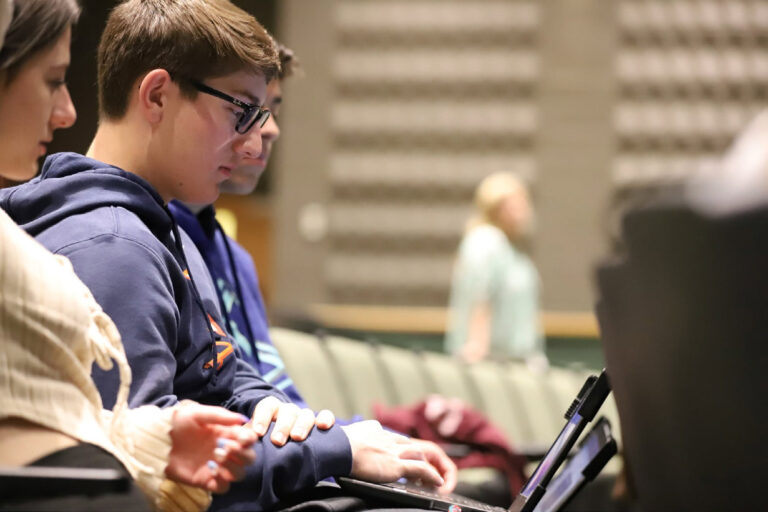
The Louisa County Chamber of Commerce (CoC) hosted an “AI impact hour for nonprofits” on March 25. Local leaders from nine different community organizations gathered to learn more about Artificial Intelligence (AI) and share with each other how they are using it to enhance their productivity in their nonprofits.

The meeting kicked off with a live zoom meeting from TechSoup, a nonprofit network of non-governmental organizations that helps provide technical support and technological tools. Director of equity, inclusion, diversity, and culture (EIDC) with TechSoup LaCheka Phillips shared that she began experimenting with generative AI and ChatGPT’s in November 2022, first to enhance productivity in her role. Then, she began to develop a framework of how to use AI more thoughtfully, helping her with brainstorming, drafting, summarizing, planning, and rewriting.

“What you get out of generative AI is shaped by what you put into it,” Phillips said. “The prompts provide context and that context directly influences how useful, how relevant and how accurate your responses will be.”

Phillips highlighted the difference between what she considered a generic prompt against an engineered prompt using the Google AI model Gemini. She used the example of an email to be sent out to donors with two different ways to input that prompt into an AI model.

In the “generic” prompt, she simply asked AI to generate an email to invite people to a fundraising event, with information including the date, time, and address. In the “engineered” prompt, she used descriptive adjectives, cited the goal of the event, and created a call to action in addition to other basic information about the event. Consequently, the AI model outputted a more comprehensive and organized email, which Phillips said was a direct result of using the I.M.P.A.C.T principle for how to write effective prompts.

Phillips said the input that you submit for the AI to work with must have intention (state intent of prompt), message and metric (what are the key points you want people to remember and are there any stats or numbers to be included?), purpose (what is the purpose of your message?), action (what action would you like the audience to take?), clarity (make your content clear, concise, and compact) and timing (what important dates or deadlines need to be addressed in the content?). If those questions are outlined in your input, Phillips said that this is the best way for an AI model to give you the best results.

Tracy Hale Clark, the Executive Director of the CoC, stopped the zoom call so that discussion could continue among the Louisa representatives. Clark shared her experience with ChatGPT and advocated to not put boundaries on what it can do.

“Give [AI] a role,” Clark said. “You have to tell it who it is.”

For example, Clark likened her experience with ChatGPT to hiring a grant writer — a grant writer can’t just perform their duties in a vacuum, but they rely on clear instructions and expectations if they are to do their job effectively.

Nicole Copeland, the operations manager with the Louisa Arts Center, highlighted how ChatGPT helped her create an upcoming program for a Taylor Swift summer camp for kids.

“It gave me hundreds of projects and ideas they could do with their week at camp,” Copeland said.

Copeland also uses AI to create graphics on their website. For the upcoming event “Introduction to Crochet” on April 18 and 25 at the Louisa Arts Center, Copeland used ChatGPT to help flesh out a description for the event and generate the image.

The group discussed some of the ethical concerns with AI usage, ranging from inputting sensitive information like budget numbers to using it as a crutch. Clark emphasized that AI doesn’t replace one’s thinking but helps organize how your unique brain works to strategically address an issue, like grant writing.

“You know what you want to emphasize and what’s important – AI doesn’t,” Clark said. “AI doesn’t know what’s important to your business and doesn’t know what’s important to you…I use ChatGPT as an employee and brainstorm back and forth…I see it as a compliment to my team to work through things with, especially in organizations [with few people].”