Local Tea Party meets, discusses redistricting, election integrity
Concerns over Virginia’s proposed redistricting amendment and the integrity of electronic voting systems dominated a March 26 Louisa Tea Party meeting at Roma’s Italian Restaurant, where speakers and attendees debated issues ranging from political power to whether local election equipment should be independently tested.

The event was organized by Louisa Tea Party President James Thorton and drew roughly 30 attendees. Multiple speakers familiar with both aforementioned topics addressed the audience throughout the evening before later being challenged by a member of the audience.

Following prayer and the Pledge of Allegiance, Louisa resident Dr. Michael Huffman, a professor of constitutional law and executive director of the Virginia Assembly of Independent Baptists in Richmond, was the first to speak, outlining his recent work involving state legislation.

Huffman said he works closely with delegates and senators in Richmond to ensure that laws in the commonwealth do not impede religious freedoms, but noted that his recent attention has shifted to HJ6007.

According to Huffman, 44% of registered voters in Virginia are Republican and 55% are Democrat, with six Democrats and five Republicans currently serving in Congress, figures he said already reflect a level playing field. If passed and new lines are drawn, the consensus among Republicans is that Democrats would then gain a 10-1 advantage.

“That means 44% of registered Republicans in the commonwealth will be represented by 91% Democratic representation in Washington,” Huffman stated, arguing that the resolution was first introduced during a special session last year that was designed specifically for the budget. “There’s absolutely nothing fair about that. In fact, there’s absolutely nothing legal about that.”

Democrats on both a local and national level have stated that redistricting is essentially a response to gerrymandering in other states such as Texas and that they must use the temporary measure as a way to level the playing field until the next census in 2030. Huffman acknowledged those actions elsewhere were wrong but argued they do not justify similar action in Virginia.

“I wish I had a dime for every time I keep hearing [Trump’s] name…now I may get flogged out of here for saying this, but oh well, my organization does not give Donald Trump a free pass,” Huffman stated. “When he does something unconstitutional, we say it. Him going into other states and convincing them to redraw inside of that 10-year period was beyond his executive power. He should not have done that. Now here in Virginia, they’re trying to make us pay the price.”

Huffman also accused Democrats of violating Article 12, Sections 1 and 2, of the Virginia Constitution and raised concerns about early voting procedures, specifically referencing Section 30-13 of the Code of Virginia. He stated that the clerk in Louisa, along with clerks in numerous other localities, did not receive a copy of the resolution within the legal timeframe, if at all.

He concluded by arguing that the issue centers on political power.

“Yes, they broke the law, but what else is new for a Democrat? They learn to lie before they learn to talk,” Huffman stated, also mentioning a $5 million price tag for the special election that he said will fall on Virginia taxpayers. “The Bible says when there is a lie in the heart, it is to cover up deceit, and that goes for anybody… but make no mistake, this is all about power.”

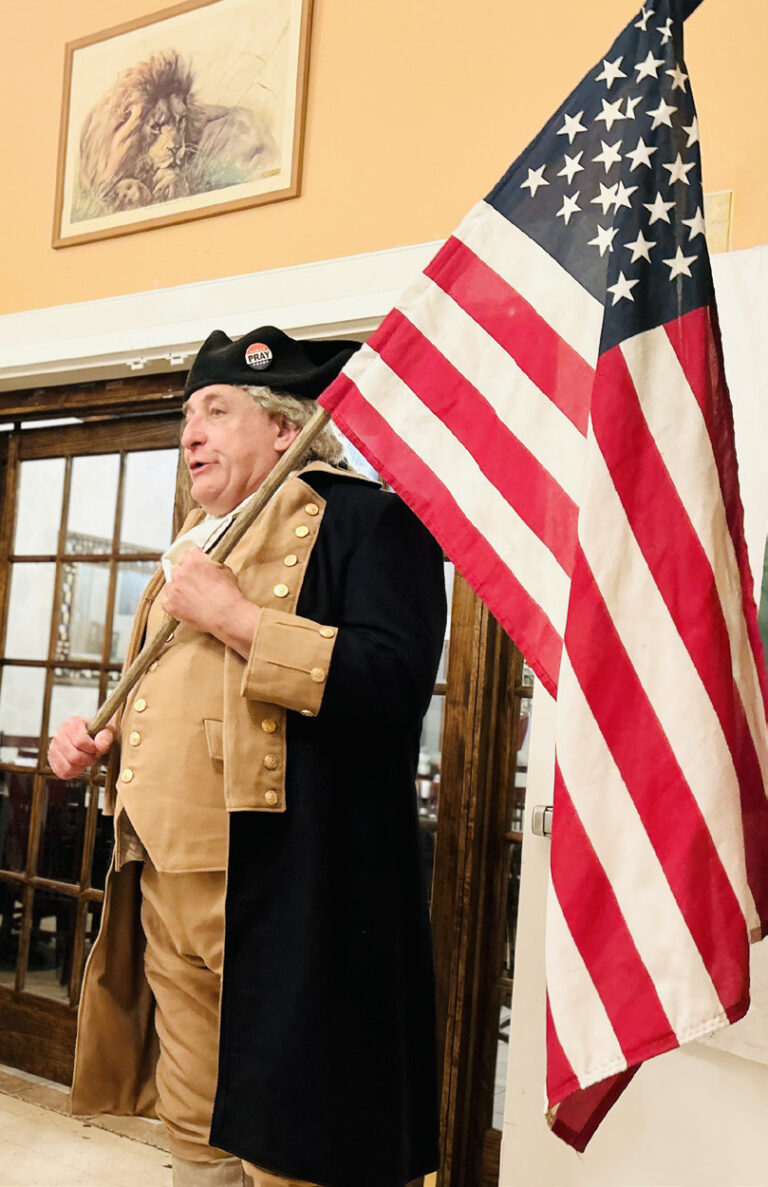
The next speaker was James Manship, a former member of the Navy who frequently refers to himself as the “spirit of George Washington” and appeared dressed in Washington attire.

Manship stated that on Jan. 6, 2021, he led what he described as a “counter attack” after perceiving then-Vice President Mike Pence as ignoring constitutional safeguards and the contingent voting plan. He said he crossed the Delaware reflective pool in front of the United States Capitol carrying both a United States flag and a Trump flag.

Manship said his current focus is advocating for the elimination of electronic voting machines, which he argued are vulnerable to hacking.

“We’re real proud when we get our poll watchers to go to the polls and watch for votes being stolen…when the party asks me if I’ll go and be a poll watcher, I ask them, ‘Are you going to issue me glasses?’” Manship continued in a sarcastic manner. “I need special glasses so I can see electronic ballots being stolen. That’s the issue.”

Manship said he has requested raw precinct data from locations across Virginia in order to analyze ballots but received no support. He added that he later sued the Board of Elections in Richmond, which he said was dismissed by an “Obama appointed judge.” Manship also said he filed lawsuits against Kevin McCarthy and Mike Johnson after they failed to act on constitutional issues, saying those lawsuits were mainly intended to draw their attention.

Manship said he has advocated for paper ballots since 2012 and believes ballots should be counted entirely by hand rather than by scanners, noting that several countries and states use that method.

“I always say this: beware of ambitious unprincipled people who will seize the reins of power. That’s what we are seeing in both Virginia and the United States,” Manship stated, adding that he was nearly arrested for promoting the destruction of voting equipment due to a misunderstanding. “In addition, beware of innovations that would undermine this Constitution or overthrow it…what are these innovations? Electronic voting machines… we’re supposed to have secret voting but not secret counting. The old touch-screen machines were even better than the ones we have now, but Governor [McAuliffe] got rid of them and brought in scanners.”

Manship also recited an acronym he created — R.O.A.R., which stands for Recover Our American Republic — and said prayer is important, but much like Washington, so is active civic engagement.

During a question-and-answer session, former Louisa Electoral Board member David Koegle challenged Manship’s claims regarding electronic voting machines.

Koegle, who served on the Louisa Board of Elections for seven years, stated that the concerns being described did not reflect Louisa County’s election procedures.

“I can assure you that citizens of Louisa County had fair and proper elections,” Koegle stated. “I was there to make sure that the testing was done correctly. I don’t want to hear this stuff.”

Koegle added that an electoral officer in Louisa County had previously compared tabulator data from a Dominion machine against printed election results.

“It compared correctly 1 to 1, without any errors,” Koegle clarified. “A lot of what you’re saying is incorrect, and by doing so, you’re making these people think that our voting system is not fair.”

Several attendees pushed back, responding that while Louisa’s elections may have been properly conducted, concerns still exist in other localities across Virginia. Koegle said he agreed but argued that specific locations should be identified when allegations are made. He added that electronic voting systems are more accurate and less susceptible to fraud than manual counting.

“Hand counting ballots are not an accurate means of counting ballots,” Koegle stated.

Thorton then suggested a possible test of local voting equipment as a solution to concerns.

“I’ve got a great way to solve this problem. Mark Cook is coming to Virginia next month. How about Louisa County offer up one of their machines and we will see if we can hack it?” Thorton stated.

Although labeled an election-denier by watchdog groups such as American Oversight, Cook is an activist and election integrity consultant behind the “Hand Count Road Show”, a nationwide initiative to promote hand-counting ballots as a way to increase transparency in elections.

Manship supported Thorton’s idea, saying independent review would help address public concerns.

“The only people those on the board of elections get to talk to are basically technical sales reps and engineers of the electronic voting machines,” he said. “If I’m on the board of elections, I’d want to hear what the EVM engineer says, and what the independent engineer says, and I’ll take both of them into consideration… if we have citizens that don’t believe in these things, let’s prove it to them. If it’s right, then great.”

Koegle responded that before every election in every locality, each tabulator is required to undergo validation testing.

“When I was involved, the electoral board ran the test. We set up the test requirements, the ballots, and we ran the test ourselves,” Koegle stated. “We signed off on every one. Approximately six years ago, we did a demonstration for the entire county over at the fire station on how ballots are counted. We provided a complete test deck on how it’s done, and people that left were satisfied that we were doing it right… any county that doesn’t run a [validation] test is absolutely stupid.”

Koegle added that if a hacking test were conducted, the machine would require recertification afterward, which he estimated would cost approximately $10,000. Thorton responded that he would consider starting a GoFundMe campaign to cover the expense.

“I will talk to whoever I have to talk to. If they provide a machine we will televise it and see if these machines will be hacked,” Thorton stated. “Then we can finally put this to rest, and if it passes the test we can say Louisa’s machines are some of the best in the state of Virginia…the proof is worth it.”

In a follow-up interview with The Central Virginian, Thorton noted that under current contracts, only authorized service personnel are permitted to access the machines; any tampering, even for instructional purposes, is against the law.

“That says a lot right there and doesn’t scream transparency,” Thorton stated. “If they want to officially put this to bed, why not prove it right now? Voting integrity is one of the most important issues for our country, and if we do not have faith in elections it destroys the entire foundation.”