Turf fields fees, access in question

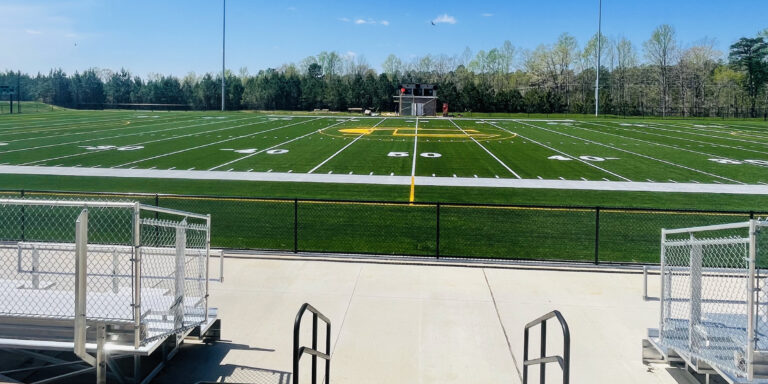
A more than $6 million investment by Louisa County for two full-size synthetic turf fields located at Louisa County Middle School is now nearing the finish line later this month, but questions remain over who will have access to the facilities and under what conditions. After exceeding its original budget by several million dollars, county officials are now grappling with how access should be structured in order to protect the lifespan of the new fields. At the center of the discussion are two local youth sports organizations — Louisa Area Soccer Association (LASA) and Louisa Youth Athletics Association (LYAA) — which are now expected to negotiate an agreement with Louisa County Parks, Recreation & Tourism (LCPRT) regarding fees and operational details.

During the Louisa County Board of Supervisors (BoS) regular meeting on April 6, supervisors were scheduled to consider approval of a parks and recreation fee schedule and turf field usage rules. The proposed schedule recommended a rate of $30 per hour per field, with a two-hour minimum, along with lighting fees of $10 per hour per field.

According to Deputy County Administrator Chris Coon, the proposed rates are intended to balance accessibility with the operational and long-term maintenance needs of what he described as a high-value county facility.

To protect the county’s investment, officials proposed controlled access to the gated fields, with full supervision required from LCPRT staff. Metal cleats and sports drinks would be prohibited on the turf, along with a number of other equipment restrictions and prohibited activities.

Under the proposed rules, users would also be required to provide a certificate of insurance in the minimum amount of $300,000 per aggregate, naming Louisa County and Louisa County Public Schools as additional insured parties with respect to liability involving sanctioned activities, practices, or play.

Leading up to the hearing, officials from both LASA and LYAA have been advocating for reduced or eliminated fees. Coming together for a common cause of youth sports, the two organizations that serve approximately 1,100 families both also requested no additional operational fees, for access during the rain, and access for local families outside of the scheduled programming. Both organizations also emphasized that they view the arrangement as a partnership with the county, expressed appreciation for the investment, and stated their commitment to serving as responsible stewards of the fields.

At the start of the discussion, Coon added a point of clarification that an existing community-based discount would apply to qualifying organizations. Groups that meet two of three criteria — serving county youth, serving seniors, or holding 501(c)(3) status — would qualify for a 50% fee reduction.

Despite that clarification, parents and organization leaders continued to raise concerns during public comment.

Danielle Campbell, travel commissioner for LASA, said the organization — which serves between 35 and 65 players and their families each season — is enthusiastic about the new facilities but concerned about affordability.

“Unfortunately, the usage price proposed does not justify the expense, and our teams will be unable to utilize this resource,” Campbell said. “As travel commissioner for LASA, I’m disappointed, as a parent and taxpayer, I’m frustrated that these fees will fall on our shoulders.”

James Wade, a Jackson District resident, 1999 graduate of Louisa County High School, and “hype man” of LYAA, said he was concerned about the impact fees could have on participation.

“I’ve always been a shoulder to lean on and I’ll scream for any kid out there, so it’s just going to be sad to see some of the kids not be able to afford to play,” Wade said. “I understand the fees may not be waived all the way, but hopefully it will be as low as possible. It would just be heartbreaking to see a kid sitting on the sidelines because their family could not afford it.”

Melissa Young, a parent of two sons involved in youth sports, echoed those concerns.

“ If the proposed pricing puts these fields out of reach for youth organizations, you’ve built something our community can’t actually use,” Young said. “High facility fees will either price them out of the turf completely or force rate increases that force families out of the programs.”

Jonathan Christian, a LASA board member and coach, said affordability has long been a priority for the organization.

“At LASA, we have drawn a line in the sand and we are about three to seven times cheaper than comparable clubs,” Christian stated, saying the organization has gotten creative when it comes to pricing. “Our travel teams are starting to bring home hardware from major tournaments, and yet, we still have players that can’t afford shoes. Instead of having these families pay to play, we have decided that cost should not be a barrier.”

Coon presented pricing comparisons with surrounding jurisdictions, stating that Louisa’s proposed rates remain significantly lower than many nearby localities and describing the facility as one of the most affordable options in the region.

He reiterated that fees are necessary for ongoing maintenance and overall upkeep to sustain its longevity.

During a November 4, 2024 Board of Supervisors meeting, when supervisors approved an additional $2.77 million budget supplement for the project, Coon described the turf fields as having “high community and revenue potential with reduced maintenance needs.” Supervisors have also previously discussed attracting outside tournaments to generate revenue.

Coon explained that standard field restrictions are intended to prevent accidental damage.

“We need to make sure individuals don’t do something inadvertent — like drink red Gatorade that spills and stains the turf for the rest of its life,” Coon said.

He added that lower costs could lead to increased demand and reduce availability for Louisa County residents.

Under the proposed schedule, Louisa County Public Schools (LCPS) would receive priority access Monday through Friday from 3 p.m. to 6 p.m. Parks and recreation programming would receive second priority, with remaining time allocated to community users and youth organizations based on availability and equity.

Coon also clarified that the turf may be used during rain, provided there is no lightning.

Jackson District Supervisor R.T. “Toni” Williams began by addressing a few basic concerns, stating that he has no problem with controlled access to the facility.

“If you want to use The Jungle, you cannot just go in there and use The Jungle. It must be reserved and somebody has to be responsible,” Williams said. “If somebody shows up in a pair of metal cleats and they don’t know better and they tear it, you come back and you’ve got problems.”

Williams also said he believes the fee schedule was wrong and that users from outside Louisa County should pay higher rates.

“Maybe I’m in the minority, but I don’t care if they come or not…if you’re not from here and you want to use our fields and you have no connection to the county, you should be paying $150 an hour — that’s my personal opinion,” Williams stated before polling the audience on whether or not they were satisfied with the discounted rate strictly for youth organizations or whether it should be free. “…I’m not sure we’re going to make you happy tonight, but we are going to do the best we can.”

In the opinion of Mountain Road District Supervisor Tommy Barlow, the existing proposed fees when divided upon each individual organization were “not a significant cost”, and that the $6M+ investment is also falling on taxpayers that do not use the fields.

Louisa District Supervisor Manning Woodward disagreed, and stated that it is indeed a significant amount when spread over a full season. He added that it will likely not be as pressing of an issue in the future.

“As these fields age, we probably won’t see as big of a deal out of all this stuff,” Woodward said. “It’s all new right now and new to us. Fields do not stay nice if you just let anybody come in and use them. Not everybody is like the folks in this room tonight that know how to take care of things. In a perfect world yes, but we live far from a perfect world.”

Cuckoo District Supervisor Christopher McCotter reiterated that he did not initially vote in favor of the turf fields, but agreed those outside of Louisa County should pay more. He added that it was “mind-boggling” that a paid staff member would have to be on site at all times.

“Why didn’t we think about this ahead of time? This is creatively planned and we will leave it at that,” McCotter stated. “For me to vote for taxpayers to have even more responsibility to use the fields is inconsistent with my initial position.”

Williams then proposed a one-year trial beginning May 1 under which LASA and LYAA would be exempt from hourly fees and would have to negotiate a memorandum of understanding (MOU) with county staff.

However, he emphasized that turf access should not replace all use of existing grass fields.

“You need to remember that there are still grass fields and you can practice on them just as well as you can practice on a turf fields — the difference is we don’t have to pay a county employee to watch you while you practice on the grass,” Williams stated. “Just because there’s a turf field doesn’t mean it needs to be used for every practice. What I don’t want to see is [LCPRT Director James Smith] having somebody down there seven nights a week and four hours a day…that’s unreasonable and we’re not going to do that, and [Smith] can regulate that in the MOU.”

Mineral District Supervisor and Chairman Duane Adams said he did not want the board directly involved in negotiations and that details should be worked out between the organizations and LCPRT.

McCotter said he believed the board was “putting the cart before the horse” and argued that a MOU should be finalized before supervisors take action.

The board ultimately voted to table the matter until later this month, allowing time for a MOU to be developed.

In a follow-up interview with The Central Virginian, Campbell said she remains optimistic.

“I think the Board of Supervisors made the right decision to ask LCPRT to go back to the drawing board and work directly with the youth organizations who hope to be significant users of the fields,” Campbell said. “I feel confident that this direct collaboration will result in a solution that works for everyone.”