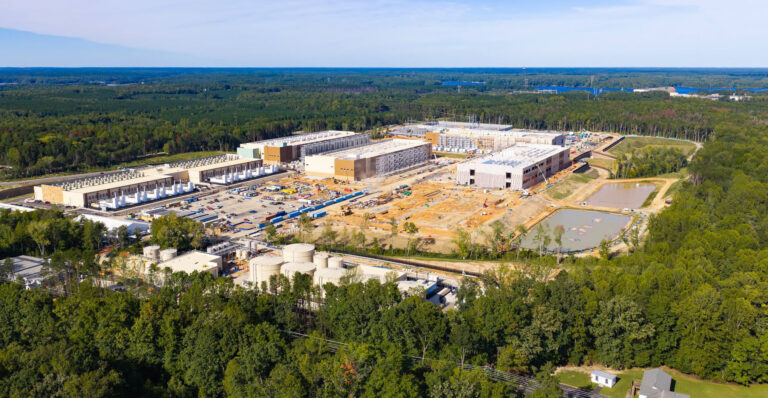
Defending data center development

The Louisa County Board of Supervisors (BoS) took the first steps in tax reduction as a result of data center development at the April 27 meeting according to Mineral District Supervisor and Chairman Duane Adams, one of two supervisors who touted the intentionality and merits of bringing this type of industry to the county.

The BoS kept the real estate tax rate at 72 cents per $100 of assessed value and business personal property at $1.90 per $100 with a decrease in the personal property tax rate from $2.43 per to $2.07 for Fiscal Year 2027. This cuts the personal property tax rate by 15 percent.

Personal property tax includes automobiles, trucks, manufactured homes, motorcycles, recreational vehicles, boats, trailers, and aircraft according to the Louisa County website.

Jackson District Supervisor R.T. “Toni” Williams, Jr., who is on the board’s Finance Committee with Adams, stated that a rebate is something that does not necessarily carry through from year to year and a rate change requires board action, which is why they are pursuing the rate reduction. During the meeting, both Adams and Williams touted data center development as an effort to put the county on solid financial footing for the next several decades.

“We’ve been attracting data centers intentionally. The citizens should see something for that,” Williams said.

“I think it’s really important for our citizens to recognize that this board and the previous board have been very active in getting what I believe is smart economic development in this county that will help us shift the tax burden from residential home owners and personal property tax to the businesses that invest here,” Adams said. “It’s my hope that as the revenue starts to come in and continues to come in over the next several years that this is the first step towards continuing to reduce the personal property tax rate.”

Williams highlighted that 60% of costs for a new elementary school in Louisa in the next several years are already sitting in the bank as a metric for Louisa being in great financial position as a result of data center development.

“We were intentional. We went after data centers,” Williams said. “[Residents may ask], ‘what about the electricity?’ That’s not my problem. It’s not popular to say, is it? But if we don’t get it here, Goochland is going to take it, Hanover is going to take it, someone else is going to take it and you’re still going to have to provide electricity to them. Our problems are looking out for our citizens. Yes, during construction, this is difficult. But it’s not going to be under construction forever.”

Williams likened the situation to the North Anna Power Station which was constructed in the early 70’s.

“We’re going to look back a time from now and we’re going to be grateful it’s here,” Williams said. “The numbers are staggering if the general assembly doesn’t screw this up; the tax revenue from the current campuses we have of data centers will be more potentially than the operational budget of the entire county right now… we did this and I will wear this like a badge of honor.”

In addition to the tax rates, the BoS unanimously voted to adopt the FY27 operational and maintenance budget in the amount of $186,370,554 and $14,688,036 in the Capital Improvement Plan (CIP) budget. The BoS also authorized a $305,000 budget supplement to Louisa County Public Schools (LCPS) for multiple capital projects, with some projects moved from FY27 to FY26 so projects can start while school is out. These included cafeteria equipment replacement ($140,000), asphalt/parking additions/repairs ($75,000), field/complex repair/replacement ($50,000), carpet/flooring ($25,000) and furniture and fixtures ($15,000). The source of funding is the longterm LCPS capital reserves.

Deputy County Administrator Wanda Colvin shared with the board that a public hearing for changes to tax relief for elderly and disabled residents is set for the board’s next meeting on May 4 to ease the burden of rising real estate taxes.

According to the Louisa County website, if someone 65 years of age becomes permanently disabled or 100% handicapped, has an income of less than $50,000 and has less than $200,000 in total net worth, they may be entitled to an exemption on their real estate tax with maximum relief granted of $3,000.

Colvin shared that there would be an increase in income requirements of 10% at each level. For example, the program’s annual income limit would increase to $55,000.