Community meets to oppose Valley Link

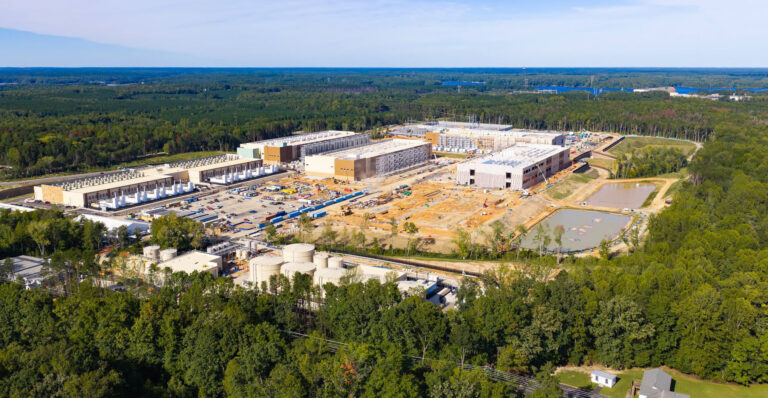
Louisa County residents are continuing to voice their concerns and disapproval of the Valley Link Transmission Project. Steel lattice structures between 135 and 160 feet tall supporting 765-kilovolt (kV) lines could potentially cut through roughly 20 miles in the county if the State Corporation Commission (SCC) approves the project. Developers aim for the line to be operational by 2029 to meet Virginia’s growing energy needs.

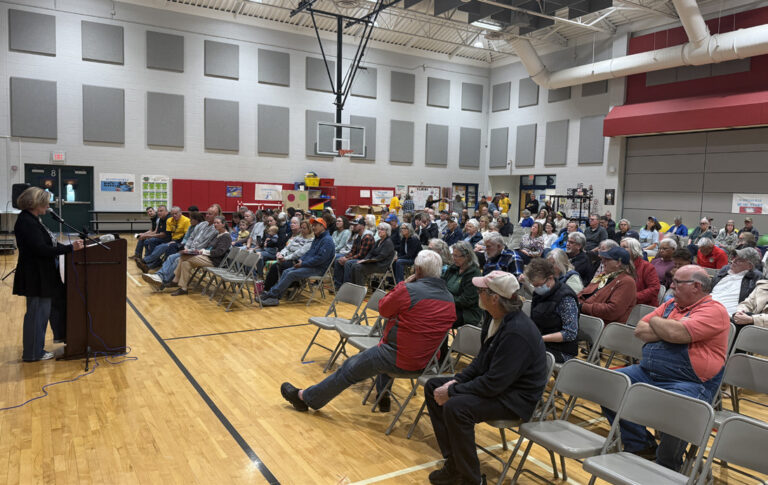
A community meeting was held on March 25 at Thomas Jefferson Elementary School (TJES), with several speakers outlining their concerns with the project. Local resident Robin Horne helped organize the event.

“Each person in this room has a story about the transmission line,” Horne said. “Whether they come too close to your house, cross your open lot, affect your business, or split your farm in half, many of these lines are impacting your timber or your pastures. Maybe you can see [the transmission line from your property] — it’s kind of hard to miss a 12-14 story tower…we all have a story. It’s time we now share it, and it’s time we start sharing it loudly.”

Horne encouraged attendees to voice their opinions in a variety of ways, including reaching out to their local elected officials as well as representatives at the state level, as well as through letters to the editor in The Central Virginian or their own local newspaper if they were from a different county.

“Writing a letter can start a meaningful conversation and influence policy makers and elected officials either directly or indirectly,” Horne said. “It also is a good way to educate the public about specific matters and you are free to express yourself in writing.”

Horne attended a joint meeting held on March 24 with the Orange County Board of Supervisors and Planning Commission with the focus on the Joshua Falls-Yeat electric transmission line proposal. The line is planned to extend from Campbell to Culpeper County, with Orange as one of the impacted counties. 86 people signed up to speak during public comment, with the meeting held at Orange County High School instead of its typical location. Horne said the board asked “great” questions and the citizens “spoke with knowledge.”

“If you’re at a loss for words, the [Orange County] board and the citizens can inspire you,” Horne said.

Mineral District Supervisor and Chairman Duane Adams was the second speaker of the evening, reiterating that it’s a “bad project” for Louisa and the other counties affected and that it brings no value to the citizens of Central Virginia.

That day, Adams said he contacted the chairman of the board of the other nine counties to host a summit in Louisa County on Friday, April 3 with supervisors and their respective county administrators. The meeting will not be open to the public.

“If we stand together, we have more of an opportunity to have a louder voice and stop this,” Adams said. “… the message has been loud and clear from Louisa to Culpeper to Campbell all over, it’s a resounding ‘no.’ This is not good for us.”

Adams reiterated that the line crosses through nine rural counties and avoids places like Albemarle, Charlottesville, and Keswick, raising the question that Valley Link may have perceived that folks in the rural areas wouldn’t organize and protest.

“We are organizing. We are protesting. We are bringing county leaders together. Everything will be on the table… including outside counsel and litigation to stop this thing,” Adams said.

The $1 billion project will be primarily paid for by utility ratepayers across Pennsylvania- New Jersey-Maryland Interconnection (PJM), the Regional Transmission Organization (RTO) that manages the electric grid and wholesale electricity markets for 13 U.S. states, including Virginia.

“Not only do we not want it…but they want us to pay for it,” Adams said.

Adams stated concern that the project isn’t following existing rights-of-way, instead going through what Valley Link has deemed “undeveloped land.” He also questioned why the line could not be buried underground. The project is a joint venture between Dominion Energy, FirstEnergy Transmission and Transource, operating as the Valley Link Transmission Company. In 2025, Dominion Energy had a $3 billion profit.

“Spend some of that money to bury this thing,” Adams said. “Spend some of that money to not impact people it shouldn’t impact. Figure out how you can do this without destroying ag and forestal land [and] negatively impacting residential values. We got a long, hard fight ahead of us…the Louisa Board of Supervisors is going to be in this long, hard fight with you and we’re going to spend some money right to the end and we are going to use every means necessary at our disposal, including legal means, to fight this thing.”

Valley Link representatives have stated that eminent domain — the right of the government to take private property and convert it to public use — will be used in the process of constructing the transmission line.

“…I heard said at one of these Valley Link meetings, ‘well, sometimes you just have to sacrifice for the greater good,’” Adams said. “Remember, the person who’s telling you that isn’t the person who has to sacrifice. They are the person that they want you to sacrifice. I think they’re going to play every game and every card they have. Well, guess what? So is the opposition. So are we.”

Andrew Guerra, a local resident who shared that he has worked in the utility sector and is familiar with the process that Valley Link is going through to get their project approved, addressed the audience after Adams.

“Most importantly, I know how to push back against these projects,” Guerra said.

PJM and the Federal Energy Regulatory Commission (FERC) are two organizations involved in the approval process for Valley Link, but Guerra highlighted the SCC as where public input really matters.

“[PJM] only looks to what is best for the power grid in regards to capacity and reliability. They aren’t looking at the impact this project will have on local communities or any residents in its path,” Guerra said. “While PJM and FERC do allow for public comments, their focus is solely on the reliability and stability of our electrical grid. They are not looking at us. This is where the Virginia SCC comes into play.”

Since SCC is the regulatory body for public and private utilities in Virginia, Guerra said it is within their scope to look at impact on local communities.

“This is our only major body that will take a close look at the comments we submit,” Guerra said.

PJM approved the Valley link transmission project as a public necessity in February 2025. The project has partial FERC approval while it awaits the SCC review and approval; Valley Link will not submit for SCC approval until September of this year.

Guerra said once Valley Link submits for SCC approval, this will be local residents “window to comment, push back, and rally together” either in person, online, or through mail. One of the first steps is for Valley Link to notify local officials of their intent to file — this is where county board members and county officials should push back and share their disapproval, Guerra said. The application will be online for public review at SCC.Virginia.Gov.

“This is where we will get some additional answers to the questions we’ve been asking at these open houses,” Guerra said. “They’re required to show us the financials of the project, routing options, potential impacts and details of projects. A lot of this is going to be information that they’ve been reluctant to share thus far…the truth will actually be in the application because that’s what is actually reviewed.”

Guerra outlined the following process: when the SCC issues a procedural order, this is the opportunity where people can request formal participation in the case as a respondent or create joint representation. This could be community representatives and not necessarily a law firm. Once formally requested, then those individuals are included as a part of the process. Once the procedural order is in place and the Virginia Department of Environmental Quality (DEQ) has issued their first report on the project, the public comment period, typically a 30day window, will open.

“It’s extremely important to generate as many comments as we can during this time,” Guerra said.

Once the comment period has concluded, public hearings will take place in multiple counties, Guerra said, and Valley Link will be required to address community concerns in front of the SCC. After those public hearings, there will be one more opportunity to send additional comments based on Valley Link’s response to community concerns. Once the last public comment period closes, there will not be another opportunity for citizens to voice their concerns.

Guerra stated the process is “confusing and complex,” but one of his goals is to keep track of the events and make some guides as the process opens up.

The Heritage to Mosby project, Dominion’s proposed 525-kV line in Northern Virginia, is currently set to carry power underground for 185 miles. Guerra pushed back against a narrative stated by Valley Link that it is not possible for the current line to be built underground.

“I know many people in this room have asked why the Valley Link project can’t be underground,” Guerra said. “They keep telling us it’s not possible. That’s just not true. They’ve done these lines underground. They can transmit underground electrical lines across the ocean…if they can afford to do it for the Heritage-Mosby line, they can do it here as well.”