Autism Awareness Festival supports individuals in community
The Louisa County Sheriff’s Office (LSCO) annually sponsors the Project First Responder Special Needs & Autism Awareness Festival, a free public event designed to highlight the variety of resources and accessibility needs available to the community. On Saturday, June 6, at Moss-Nuckols Elementary School, the LCSO welcomed more than 50 resource organizations, first responders, vendors and community sponsors to celebrate and support individuals with special needs.

Project First Responder is an initiative sponsored by the LCSO Foundation working to deconstruct the communication barrier between emergency personnel and individuals who are a part of the autism, Alzheimer’s, Intellectual and Development Disabilities (AAIDD) communities.

Lieutenant of Special Operations and Community Policing and Public Information Officer Chuck Love explained that there is a disproportionate overlap in behavior patterns associated with AAIDD and those perceived as criminal, and this disconnect can come from misinterpretation.

“A lot of times you get individuals that may not be comfortable with law enforcement,” Love said. “So as law enforcement, we put these events on to try to bring awareness to that, and to show that we’re just people, and we want to make sure that we have safe interactions with them.”

In line with this mission, more than 30 organizations attended to inform families about the various support resources available to them.

Among these organizations was Golden Grove, a behavioral health operation providing individualized Applied Behavioral Analysis therapy for children and families in Louisa and the surrounding area. Founder and lead Board Certified Behavior Analyst Britney Clark explained the significance and importance of community outreach events.

“Especially in such a rural community, not a lot of people are familiar with the resources available to them,” Clark said. “I wanted to come, help support, and show that we have a lot of amazing resources here in the county that people can access.”

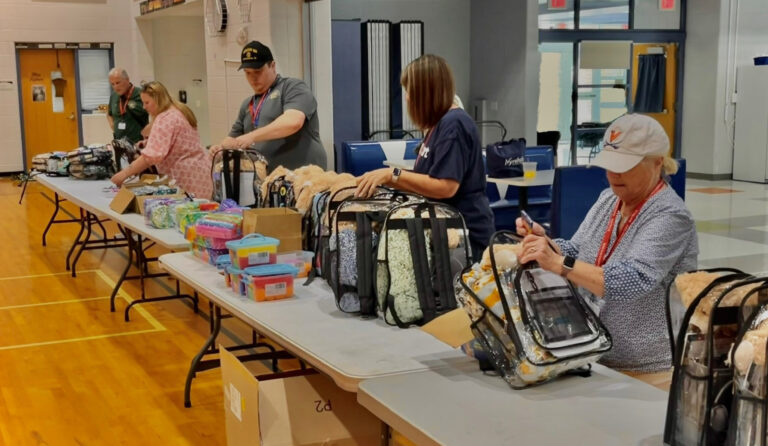
A central feature of the festival was the assembly of emergency sensory backpacks, specially created to bridge potential communication gaps between first responders and children with Intellectual and Developmental Disabilities (IDD) during emergencies.

The kits received their inspiration from Sergeant James ‘J.T.’ Mann of the Prince George County Police Department and his son Ledger Greyson Mann, a young boy with autism who helped design the clear bags. The bags are named LGM emergency sensory backpacks after Mann’s initials. Inside the bags are noise-canceling Bluetooth headphones, stuffed animals, fidget and sensory objects, a blanket, and a dry-erase board and pictogram flash cards that nonverbal or stressed children can use to communicate their needs.

Volunteers formed an assembly line to quickly and efficiently pack approximately 150 LGM bags throughout the event.

The event also featured a range of free festivities, including several bounce houses, trackless train rides, face painting and unique sensory playrooms designed to provide a safe and engaging environment for children with special needs.

“You only see cops on the worst day of your life. So I try to make it so you see cops at other fun times,” Love explained.

Stephanie Hicks, coordinator of the Piedmont Regional Education Program (PREP) Parent Resource Center, was among the participating organizations. PREP serves parents of children with disabilities by providing confidential information and training resources for families or educators with special needs children.

Hicks designed a sensory break room featuring a jungle gym of play blocks and boxes, stations for building with building blocks and a wide range of sensory-motor fidgets. She explained the technique and importance of sensory spaces.

“We have a variety of different colors and different sizes to appeal to a range of ages and senses,” she said. “Everything we chose applies to a gross motor skill. Often we expect our kids to hold still or hide with their family, and this gives them a space to take a break, get creative, and move.” Hicks also emphasized the broader importance of raising awareness about special needs.

“I am the parent of kids who went through special education, so I get it. There’s no judgment,” she said. “The more people learn, for example all the different possibilities of what is going on in the head of a child who is nonverbal, the more inclusive we become, the more accepting, then the easier it becomes for all our kids to participate in our community.”

TCV Staff
TCV Staff
Articles: 48