A late ‘thank you’ to a Louisa comedy legend

“Monty Python and the Holy Grail” fractured my brain as a young adolescent.

Most people can pinpoint a movie that instantly takes them back to a time and place, whether it’s a first date with a loved one, a horror movie seen at too young of an age, or a holiday movie that is a prerequisite to get in the Christmas spirit.

My parents were never super keen on watching the latest Disney film — some of the earliest films I remember watching include “The Blues Brothers”, “Jurassic Park”, and “Terminator 2: Judgment Day,” before I was of age to even go to a PG-13 movie myself.

When I was around 11 years old, my dad put on the British comedy film, “Monty Python and the Holy Grail,” with the only warning that my twin brother and I were in for a treat.

I remember being hypnotized by the film, not necessarily laughing, but in awe of the zaniness on screen.

I didn’t know a movie could behave like that, so outside the realm of “normal.” Why didn’t the film have a budget for a real horse? How did the Black Knight survive what is obviously more than a “flesh wound?” And what kind of ending is that? The audience wants to see King Arthur and Sir Bedevere the Wise finally reach the Holy Grail, only for a swarm of British cops from the 70s to quite literally interrupt the scene and the ending of the movie itself.

Immediately once the movie was over, I recall instructing my dad to start it over from the beginning, as if to verify what I had just witnessed wasn’t a fever dream.

I must have seen that movie a dozen times in the following months.

My brother and I would bring our neighborhood friends over to our house to watch the film, and while they sat perplexed, we would howl with laughter. For our 12th birthday, we asked for The Complete “Monty Python’s Flying Circus,” boxset, six CD’s and all 45 TV episodes of their absurdist and surreal humor.

Some of the parodied idiosyncrasies of British life definitely went over our heads — like their apparent affinity for SPAM, what the “Ministry of Silly Walks” was supposed to mock, or the various politicians and British elite from the 60’s who were ridiculed — but we still loved it.

The six members of the comedy troupe, collectively known as “Monty Python,” started an early love of mine for skit humor. Skits, or sketches, are simply short, humorous and/or satirical performances. Each of the “The Flying Circus” episodes consisted of several skits, and even their feature length films like “The Meaning of Life” and “Monty Python and the Holy Grail” can be seen as a series of interconnected skits that form one overall narrative. Today, Saturday Night Live (SNL) is probably the most well-known modern purveyor of skit comedy.

Growing up, my brother and I would watch YouTube videos to find examples of skit comedy. We would laugh at SNL and MAD TV, but our favorite was The Whitest Kids U’ Know (WKUK). An American comedy troupe that was only aired on the Independent Film Channel (IFC) cable channel, most of their audience found their skits through YouTube. While certainly inspired by the absurdity of “Monty Python,” their skits often bordered on the irreverent, immature and vulgar — otherwise known as perfect middle school boy humor.

Trevor Moore, the leader of the WKUK, has strong ties to both Central Virginia and Louisa. In his first television effort, he hosted “The Trevor Moore Show,” a short-lived public-access show that aired in Charlottesville from 1997-1999. He was only 17 when the show started, and it became a hit with local students at the University of Virginia.

In 1999, he moved from Charlottesville to New York to attend a School of Visual Arts film program; in his last year of college, Moore was granted a personal internship at SNL and was asked to stay for an entire year. But Moore had a desire to start his own comedy troupe. He formed WKUK with four other individuals (Sam Brown, Darren Trumeter, Timmy Williams, and Zach Cregger, who has recently made national news as the director of critically acclaimed films “Barbarian” and “Weapons”), and created 60 episodes over the course of five seasons, a show that has maintained a cult-like status among its fans before it ended in 2011.

In 2013, Moore hosted an “Ask Me Anything” (AMA) on reddit, an opportunity for fans to engage with him. One user asked him what his favorite Monty Python skit was, to which he replied “The Architect Sketch,” a skit where two housing developers are seeking a “block of flats” while John Cleese proposes instead his design of a slaughterhouse with humorous results.

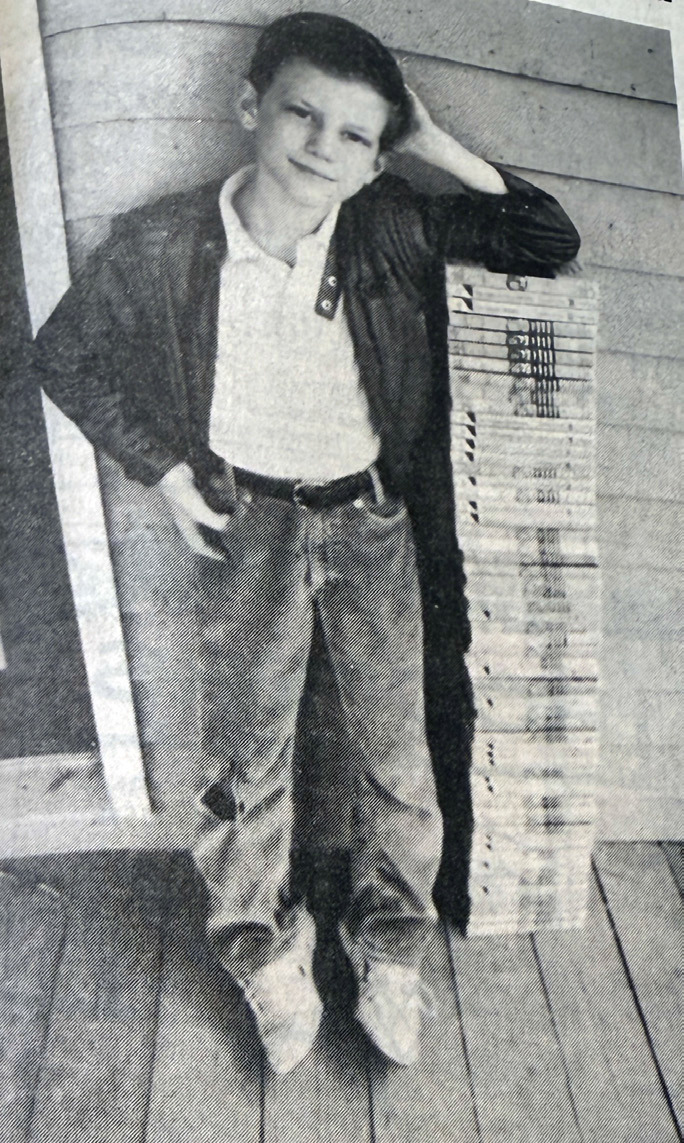
Another user asked about his upbringing, where he briefly shared that he grew up in Louisa. This didn’t mean much to me at the time because I had no personal connection to Louisa, but I was stunned while recently going through The Central Virginian archives doing research for one of my “Louisa’s Wired Future” columns to stumble upon a photo of Moore at the age of nine.

In the February 23, 1989 edition of The Central Virginian, Moore had recently accomplished his summer vacation goal to finish reading all 59 of the Hardy Boy mystery book. Moore, the son of Mickey and Becki Moore of Trevilians, received help from them and other family members as they secured the books at used book stores. The short write up states that the following September, he would enter fourth grade at Northside Christian School in Charlottesville.

I feel honored to have uncovered this small tidbit of one of my comedy heroes’ lives, but it leaves me with a weird feeling of melancholy. In 2021, I was devastated to learn that Moore had passed away after an accidental fall. Since his passing, the other members of the troupe have made it clear that they will not reunite due to the untimely passing of their friend. My brother and I still crack up at their skits, and often quote some of their material as “inside jokes” with one another. It was always my desire to meet members of the troupe, and maybe catch a live comedy show of theirs, but it seems like that will never happen now.

Life can often be difficult, and comedy — in its many forms — helps us laugh amidst our tough times and see the joy in everyday life. Whether it’s recalling childhood memories with an old friend, watching a stand up comedian perfect their craft on stage, telling a classic “knock knock” joke, or pulling a harmless prank on a co-worker, we all need laughter in some form. Laughter is a universal language; despite cultural or language barriers present, we can all distinctly tell when someone is laughing.

This is a ‘thank you’ to all of those who dedicate their lives to creating more laughter and humor around them. The world is a little more joyful because someone like Trevor Moore was in it.