Hugh Hammond Bennett

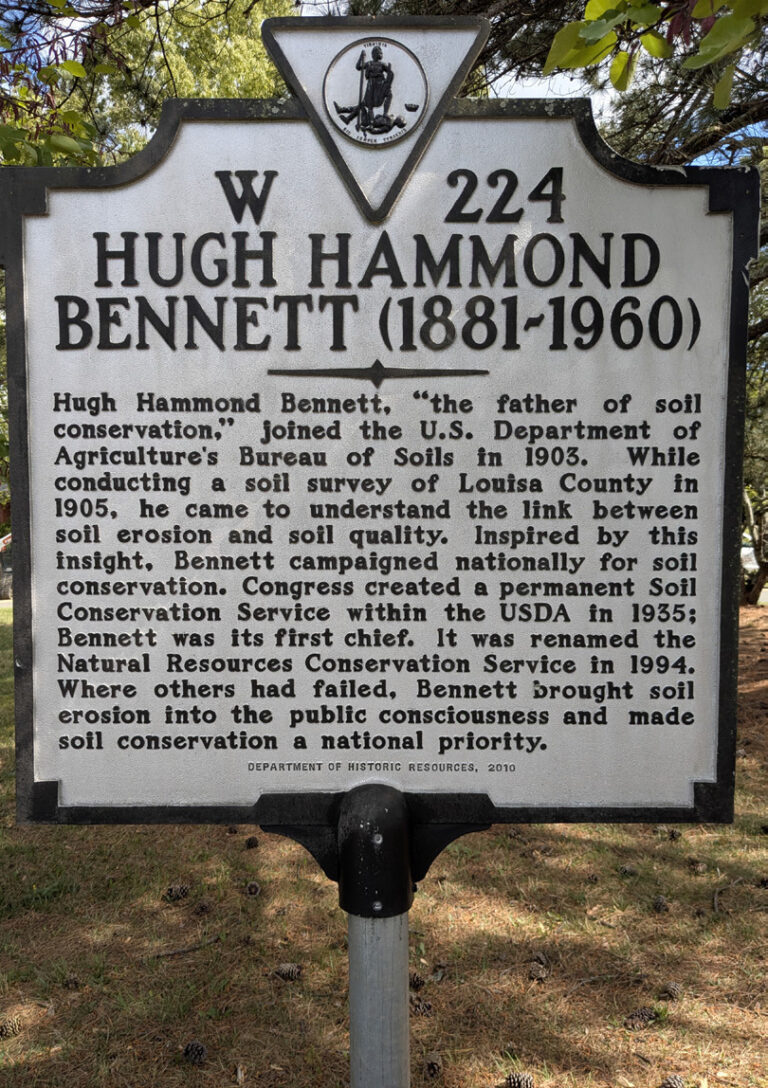
Why does land wear out? Hugh Hammond Bennett found out in Louisa County. The misunderstood problem of agricultural land use in early America led farmers who tilled the soil to just move on to better land because there were limits with repetitive tillage and deteriorating soil quality. Things changed in 1905. Hugh Bennett and another soil scientist compared adjoining land parcels with identical soils and differing production capability. One parcel was forested; the other cultivated. The forested parcel has never been cultivated; the other parcel had been tilled and planted year after year. Surely, Bennett thought, the soils were identical in the beginning. What changed? The difference was erosion throughout the cultivated parcel with accompanying loss of topsoil. Bennett studied soils in the United States and in other countries to reach his conclusion that soil erosion was a serious and unappreciated problem for the planet and all who live on it.
The U.S. Department of Agriculture engaged Bennet to perform a series of soil studies in 1905, one of which included Louisa County. The link he discovered between soil erosion and soil quality became apparent, inspiring him to write articles for popular magazines as well as scientific journals, and even a children’s picture book, “EROSION: How Hugh Bennett saved America’s soil and ended the dust bowl.” His family background on a North Carolina cotton farm and a college degree from the University of North Carolina left him well versed in soils and able to campaign for soil conservation. His campaign led to a professional role in the Soil Erosion Service at the U.S.
Department of the Interior in 1935. He later worked as head of Natural Resources Conservation Service at U.S. Department of Agriculture until retirement in 1951.
Bennett’s career was focused hard and fast on erosion. Erosion in Virginia is commonly caused by rainfall landing on open soil surfaces and flowing downslope in sheets taking topsoil with it. In other words, sheet erosion is the detachment and removal of soil particles by raindrop impact coupled with water flowing downslope in a sheet. Topsoil is diminished by the erosive action of rain water, leaving profitable farming behind as an often futile exercise in agricultural pursuits.
Rainwater alone was not the complete story as residents of the Great Plains could attest. The Dust Bowl years of the Great Depression provide an example of wind power and its corrosive effects on tillable land and grazing lands in the middle of the country. The Great Plains of the United States cover most of ten states from Montana to Texas, or approximately half a million square miles as shown in “Encyclopedia of the Great Plains,” pub- lished by University of Nebraska. This magnitude of erosion in a short time period caused a massive population shift away from the Midwest Dust Bowl and resettlement issues accommodating the same migrant populations elsewhere in the country. The author John Steinbeck wrote about these Dust Bowl years in his novel “Of Mice and Men,” in 1937. It was later made into a movie telling the hard luck story of two farm workers’ dream of owning their own land.
The Dust Bowl, the Great Depression, New Deal Civilian Conservation Corps (CCC) projects and a need for conservation based planning at all levels set up a link between Hugh Hammond Bennett and President Franklin D. Roosevelt. It was a link that saved our national landscape from the ravages of erosion. These two men, a scientist and a politician, convinced Congress to establish a Soil Conservation Service, which it did on April 27, 1935. It became a permanent agency within the Department of Agriculture, but would later become Natural Resources Conservation Services as it is known today.