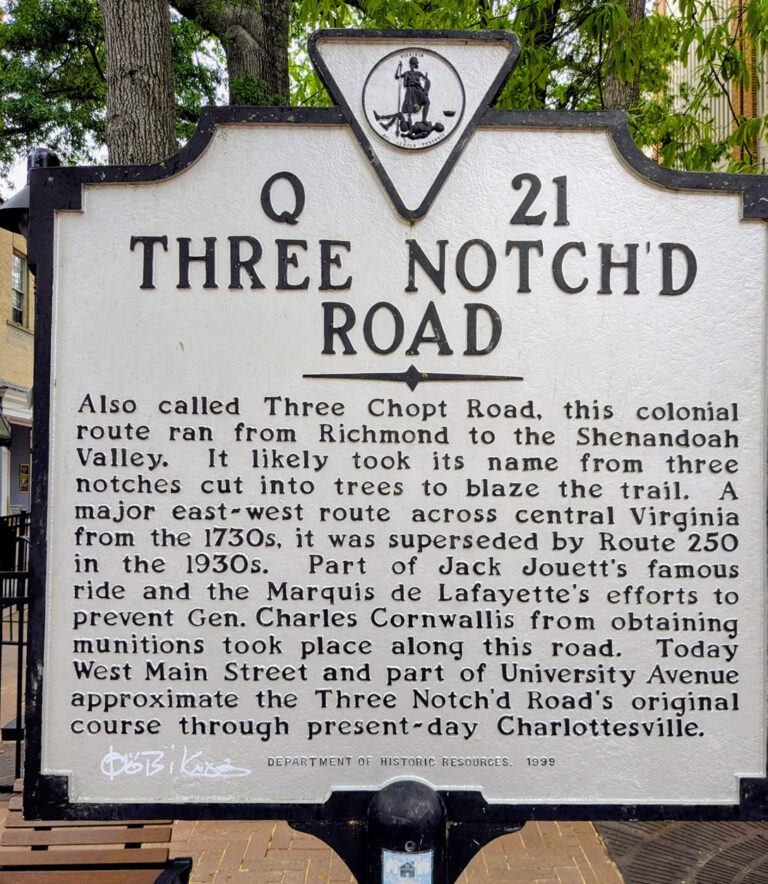
Roadside History – Three Notch’d Road

Once upon a time there was an old Colonial road in Virginia called Three Notch’d Road; sometimes Three Chopt Road. Its route followed an 18th century trail between Richmond and the Shenandoah Valley, most likely replacing an earlier pathway used by Native Americans. The road became a mainstay for east-west settlement patterns in Central Virginia from approximately 1730 onward. By the time of the Revolution its use as a major travel route was a well-established Colonial asset as the war came to a close. Later years saw its roadbeds improved, paved, straightened and shaped for U.S. Route 250 today. Regardless, the name and trace of the old colonial road have survived west of Richmond and on U.S. Geological Survey maps. Interstate-64 mostly followed the same path except for a diversion crossing the Blue Ridge at Rockfish Gap instead of Jarman Gap. Nevertheless, the route of the Three Notch’d Road remains virtually intact and in service from Henrico County through Central Virginia and Charlottesville to Augusta County west of the Blue Ridge Mountains.
The Virginia Highway & Transportation Research Council at UVA received a request for information about the Three Notch’d Road in December 1974 from James A. Bear, Jr., Resident Director and Curator of the Thomas Jefferson Memorial Foundation at Monticello.
He wanted to know the original route of this road between Richmond and the Valley of Virginia. The report he received is the basis for this Roadside History. Sections of Native American paths mentioned above were improved to the status of roads during the 1730’s. A road by definition is meant to accommodate wagons with wheels, not just horses and settlers on foot. Court ordered directives, Road Orders, were issued to ensure completion of necessary improvements as settlers moved into the upper Piedmont.
Research undertaken to track the history of the Three Notch’d Road required examination of 18th Century Road Orders issued by County Courts in Albemarle, Louisa and Goochland Counties. The first mention of the road is found in a road order issued by Goochland County Court in June 1733 calling for a road to be opened…‘from the Mountains (Southwest Mountains) down the ridge between the North River (Rivanna) & Pamunkey River (South Anna) the most convenient way.’ In the spring of 1734, Peter Jefferson became surveyor of the road, which came to be called the Mountain or Mountain Ridge Road.” The earliest mention of Three Notch’d Road in Louisa County is found in Louisa County Order Book 1742-1748. It was an “ordinary” license rather than a road order: “On the Petition of Charles Allen for a License to keep an Ordinary (tavern) at his house on the Three Notch’d road in this County…” Shortly thereafter on March 23, 1743, the name Three Notch’d Road appears in a Goochland County Road Order, and again on May 15, 1743, the term was used in a Goochland County Grand Jury hearing against a surveyor for not clearing a road.” The next reference in June of the same year uses the name “Three Chopt Road.” Other citations indicate a preference for use of the word “Notch’d” as the original name. That said, it should also be noted that this “Road” was known as Mountain Road in earlier times and should additionally not be confused with “Old Mountain Road” in Louisa County. Old Mountain Road exists today as Virginia Route 640 or Jack Jouett Road.
Three Notch’d Road was well known and used as the Revolution came to a close with the surrender at Yorktown. Two significant events on the Road were decisive factors in the defeat of Cornwallis: First, on June 3-4, 1781, the celebrated ride of Jack Jouett warning Thomas Jefferson and the Assembly of Colonel Tarleton and his approaching English forces and second, on June 13, 1781, the late night march of the Marquis de Lafayette from his camp in the Green Springs stopping an attempt by Earl Cornwallis to secure ammunition stored at Albemarle Old Courthouse (Scottsville). The two events started a British retreat that would end at Yorktown. The Road has quite a history.
The Route of the Three Notch’d Road, a Preliminary Report by Nathaniel Mason Pawlett & Howard H. Newton, Jr., Virginia Highway & Transportation Research Council, University of Virginia, January 1976 (Rev. September, 2003).