Observing Juneteenth

Though recognized as a federal holiday only since 2021, Juneteenth continues to grow in visibility as communities like Louisa use the occasion to reflect on emancipation and emphasize unity through shared history and education.
The Louisa NAACP Branch 7085 and the Louisa County Historical Society hosted the Parade of Churches on June 19 at 108 Meadow Avenue in the Town of Louisa in celebration of Juneteenth and Freedom Day, followed by the African American Heritage Festival on June 20 at Moss-Nuckols Elementary School.
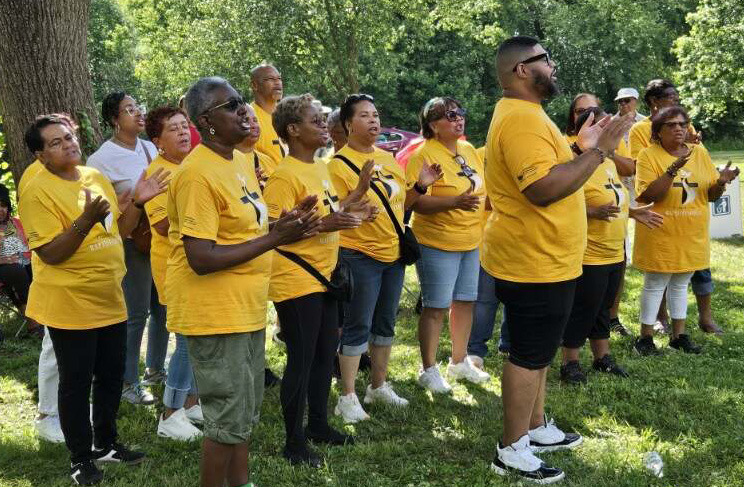
The parade was followed by a community fish fry and church performances at Louisa Town Park, bringing residents together to honor the history, culture and significance of the holiday.
Branch President Deborah A. Coles explained that Juneteenth commemorates the day enslaved African Americans in Texas learned they had been freed. Although President Abraham Lincoln issued the Emancipation Proclamation on Jan. 1, 1863, news of emancipation did not reach Galveston, Texas until June 19, 1865, when Union Major General Gordon Granger issued and enforced General Order No. 3.
“When we come together today, we come together with thanksgiving in our hearts that we are no longer bound by the chains of slavery and we can now worship and mingle freely,” Coles said.
While Juneteenth commemorates the announcement of freedom to enslaved people in Texas, Lincoln’s Emancipation Proclamation did not immediately end slavery throughout the United States. The proclamation applied only to enslaved people in Confederate states that were in rebellion against the Union and did not affect slavery in the loyal border states of Delaware, Kentucky, Maryland and Missouri. Certain Union-controlled areas within Confederate states were also exempt.
Slavery was not fully abolished nationwide until Dec. 6, 1865, when the 13th Amendment to the U.S. Constitution was ratified, legally ending slavery throughout the country. Because of that distinction, some in attendance noted that historians view Dec. 6, 1865, as the date marking the complete abolition of slavery in the United States and place greater emphasis on that milestone than on Juneteenth itself. The NAACP, however, has consistently recognized Juneteenth as an important commemoration of freedom while honoring both dates in the continuing pursuit of civil rights.
Coles said many local churches were invited to take part in the Parade of Churches, though not all accepted the invitation. She expressed hope that participation will continue to grow as awareness of the holiday increases.
Numerous congregations performed songs for the audience, including a rendition of “This Little Light of Mine.”
“Each church that participated had the opportunity to share a little bit of their vision of freedom and equity,” said Coles, who is also a member of Rising Sun Baptist Church in Mineral. “We’re just all working together to make life work.”
As Juneteenth continues to gain recognition nationwide, Coles believes education remains essential to achieving the holiday’s broader purpose.
“I think it’s becoming more accepted as a holiday in the African-American population more so than others—but then again I don’t really know because I don’t go around and ask people ‘hey, what do you think about this holiday coming up,’” Coles said. “It wasn’t long ago we were not celebrating [Juneteenth], but now that we have become knowledgeable of the facts, hopefully we will continue to come together to celebrate the freedom granted to us. And not just that freedom— but the freedom God gives us just to be together and be one people as opposed to being separated in this group over here and that group over there. When we can get away from that prideful nature of clinging on to our groups and embrace others then we will really be able to celebrate Juneteenth.”
Louisa County Historical Society Executive Director Katelyn Coughlan highlighted the organization’s ongoing efforts to preserve and share African American history in Louisa County. Recent projects have included historic preservation work with Philippi Christian Church on the Cuckoo Colored School Preservation Project and assisting Bright Hope Baptist Church in receiving recognition on the National Register of Historic Places.
Coughlan said the historical society’s involvement in Juneteenth celebrations has expanded significantly in recent years.
“When I came to Louisa the historical society didn’t really do anything [to celebrate Juneteenth], we were just open,” Coughlan said. “After it became a federal holiday I was very adamant that if we’re going to be open we should celebrate just like we do for Veterans Day… trying to highlight what emancipation looked like here in Virginia is our goal.”
During the African American Heritage Festival on June 20, the historical society hosted exhibits on oral history and genealogy, along with children’s activities designed to showcase what life was like for enslaved children prior to emancipation.
Rev. Larry E. Lewis served as emcee for the festival, which featured educational displays, community organizations and service initiatives, including Family Matters Family Resource Center of Virginia. Attendees recited both the National Anthem and the National Black Anthem before a performance of “Free the Mind” by Alex Zan.
Among those celebrating during the festivities was Dr. Essie P. Knuckle, a community advocate, author, philanthropist and retired clinical criminal forensic psychologist. Knuckle reiterated the purpose of bringing together all groups in order to strengthen the community.
“One of our missions in the NAACP is to embrace everybody, we want unity and all types of people working together,” Knuckle said.
Knuckle, who is also a member of County Line Baptist Church, reflected on the favorable weather that greeted this year’s festivities, a stark contrast to the thunderstorms that impacted the Parade of Churches the previous year.
“There is somebody greater than we are to give us such a beautiful day and such camaraderie,” Knuckle said. “This was just a wonderful time.”