Sauna Mountain Valley brings ‘Porch & Parlor Rock & Roll’ to Louisa

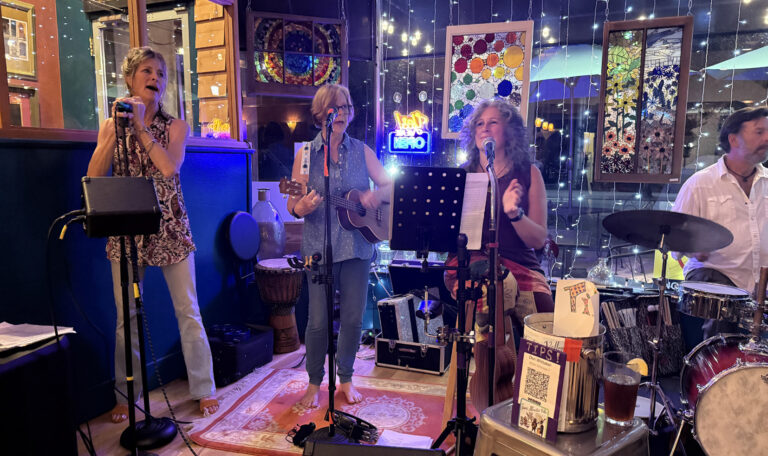
What unites Sauna Mountain Valley (SMV) is not the routine of another gig to pay the bills, but a love of what is created when seven musicians come together and create music. SMV plays their self-described “Porch & Parlor Rock & Roll” to almost exclusively Louisa audiences at places like Obrigado, Everleigh Vineyards, and The Cooling Pond, but it’s their band arrangement — three married couples, a mix of professional musicians and people who just love to create music — that adds to their overall sound.

At a gig earlier this month at Obrigado, SMV played a sprawling setlist of everything from David Bowie’s “Starman”, the Beatles “I’ve Just Seen a Face,” to the Grateful Dead’s “Bertha”. But it was the raucous, noticeably upbeat version of “Let it Bleed” by the Rolling Stones that moved the audiences to get to their feet and dance.

Vocalist and acoustic guitarist Linny Greer belted out Jagger’s lyrics of, “we all need someone we can lean on”: Bruce Courson added piano to make the song pop with the country/blues feel: Virginia Courson wailed on the harmonica: Nancy Charlton strummed along on the ukulele: percussionist Don Whitaker provided the steady drumming while Pam Whitaker added the percussive element of the tambourine; bassist Matt Baldwin anchored the groove to provide the bridge between the drums and melody. Together, they create a sound reminiscent of their musical heroes but still uniquely their own.

Linny Greer

Greer has been playing guitar for sixty years; he learned songs by ear and by reading sheet music because lessons never stuck with him.

His first time playing publicly was in Fredericksburg in 1973 and one of his earliest gigs was at the Mineral Bluegrass festival. On that same bill was Old & In the Way, which featured David Grisman and Jerry Garcia of the Grateful Dead fame. Unfortunately, he admits he just “buzzed into the gig” and didn’t get a chance to meet them.

After that, Greer didn’t play for a long time. He spent some time in Florida and then came back to Richmond and got together with friends for some jam sessions. Some of his buddies had too much to drink at a bar and started playing and the manager asked if they were available two weeks later to fill in. The friends called up Greer and asked him to join and the gig was secured. They put together three hours of music, threw together a sound system by taking speakers from home and borrowing some amps and the gig was a success.

The group was “Leather Britches” and started out as traditional bluegrass. But Greer said they were “counterculture crazies,” so they started playing Hendrix and Stones and Dead tunes with bluegrass instrumentation.

“That became a thing,” Greer said. “We got a booking agent and manager and they booked us in colleges and bars for about five years. That’s all I did was play music. That was my base — Folk/Americana with a twist.”

From there, he played with Nobody’s Reel which morphed into North 40; then he moved to Louisa around 2011.

SMV never really had an initial start. Greer met Jay Gillespie, a guitar player for Page Wilson from Richmond, and the two would play together until Gillespie’s passing in 2018.

Greer later picked up Bruce Courson on keyboards, a professional musician who formerly played with The Bill Blue Band. Courson leaned more toward Rock n’ Roll while Greer leaned more toward Americana; Greer said they pulled each toward the respective genres. Then, they met drummer Don Whitaker who had just moved from Atlanta with his wife Pam, a classically trained musician who plays violin, ukulele, and accordion.

When Pam started playing ukulele with the band, Greer said she enticed his wife Nancy to join on the ukulele as well. With two women folded into the band, they had keyboard, guitar, drums, two ukuleles, with several of them performing singing duties as well. Bruce’s wife Virginia later joined, providing harmonica and percussion for many of their tracks. Matt Baldwin, a music teacher at Thomas Jefferson Elementary School joined the band as their bassist. His wife, Caroline, a classical musician who plays cello, will occasionally join the band on stage for songs like “Eleanor Rigby”, making the band an 8-piece with four couples sharing the stage together.

“We’re just as diverse as we could be,” Greer said. “We play for fun and we don’t play all that often…it’s a party when we play and we’ve got a group of 30 people who [regularly] come to see us.”

The group hardly plays more than 13-14 gigs a year, which is a choice, Greer said. Several of the band members are retired, others are in fulltime careers. But they choose to be in SMV because of a shared love of music and performing on stage.

To consciously avoid that situation of music becoming a chore, the group is constantly learning new music and brainstorming new song ideas. Everyone in the group has an opportunity to veto a song if they don’t want to play it.

“Bruce and I particularly, and Don, know what it is when it’s a grind — and we don’t want to do that,” Greer said.

Bruce Courson

Courson has been playing piano since he was around seven years old; early on, he would just bang on the piano, but then he started taking lessons when he was eight. He credits a teacher who gave him lessons up until the end of high school and without that great teacher, Courson said he probably would have dropped piano and played guitar.

Since Courson grew up during the “British Invasion” in the mid-1960’s, he was exposed to the way English musicians treated the American blues, noting influences like The Beatles, Savoy Brown, and Fleetwood Mac, particularly the Peter Green era. At the same time, he was listening to both the Chicago Blues and the Delta Blues. He credits his style of playing to Nicky Hopkins, who played with bands ranging from the Beatles, the Who, the Rolling Stones, and Jefferson Airplane.

He started playing in bands at the age of 13, and all throughout high school played in cover bands. From 1973-1980, he played with blues artists Bill Blue in The Bill Blue Band. Courson recorded three albums with Bill Blue and traveled up and down the east coast, mainly opening for bigger name acts like B.B. King and ZZ Top. After playing with Bill, Courson went through a number of different bands while also focusing on recording. From the beginnings of the 2000’s up until 2012, Courson played with slide blues guitarist Terry Garland.

Courson eventually met Greer and Gillespie; he had a hard time at first adjusting to playing cover songs as he was accustomed to performing originals among the blues standards over the years. But as he has gotten older, he admits that playing cover tunes seems to fit with the dynamic of SMV.

With the passing of Gillespie, Courson was unsure of the direction of SMV. They would play together at parties and have a good time, but it wasn’t until the band added the ukulele’s, harmonica, and percussion with the addition of Pam, Nancy, Virginia, and Don that he felt the band took a different direction for the better.

Courson reiterated the reason SMV plays is because of the love of coming together and playing music — that’s one of the reasons why they don’t travel often outside of the Louisa limits to avoid the stress of hauling band equipment and long hours on the road.

One of the hidden strengths of SMV, Courson said, is their ability to find great B-sides songs that don’t get as much airplay, noting Stones songs like “Factory Girl”, “Dead Flowers”, and “Sweet Virginia”, which has traditionally been their closer for the past several years.

“We try not to do the songs that were really popular,” Courson said. “We find a good song on an album by a band and we decide to do that. It’s not always the case, but it’s true with the Stones — we’re not doing their big hit songs…it’s fun to look out into the audience and see people singing along with them. People know these songs — they just don’t hear them on the radio.”

Don Whitaker

Whitaker started playing drums in fifth grade; he remembers being amazed at rock band KISS and American jazz drummer Buddy Rich. His next big phase was being introduced to the drumming of Stewart Copeland in The Police and Neil Peart of Rush, while always acknowledging the prowess of John Bonham in Led Zeppelin and Charlie Watts in the Rolling Stones. He remembers mimicking Watts drumming style in 7th grade by keeping his right hand off the hi-hat on the snare beat of the two and the four.

“My influences are very broad,” Whitaker said. “The underlying motor for me is R&B, James Brown, Parliament Funkadelic, and old school Allman Brothers.”

Today, he is the principal timpanist for the Albemarle Symphony Orchestra, while he and his wife Pam play together in the Rapidan Orchestra and SMV.

After moving to Louisa from Atlanta, he met Bruce and Linny while they were playing during a party. He first met Gillespie, who he said had a general dislike of drummers; but after his passing and the tumultuous COVID pandemic, Whitaker was thrown into the band.

Greer credits Whitaker for coming up with their moniker of “Porch & Parlor Rock & Roll.

“It’s that blending of Americana and standard rock like the [Rolling] Stones,” Greer said. “We’re basically acoustic except for the keyboards and the bass — that’s the porch. We can set up on a front porch and play. We want it to feel like an at-home thing, like we’re playing in our living room playing for you. That’s how it comes off on stage and how we gain people.”

With several of their members having been in the music scene for so long, Whitaker said that the variety of the band is what motivates the love of what they do.

“We play music that we want to play, that we enjoy playing, with people that we love playing with, and sharing that with people that we love,” Whitaker said.

To find out about Sauna Mountain Valley’s next gig in Louisa, check them out on Facebook.

Mitchell Sasser
Mitchell Sasser
Articles: 35