Louisa Supervisor hints at future additional reservoir
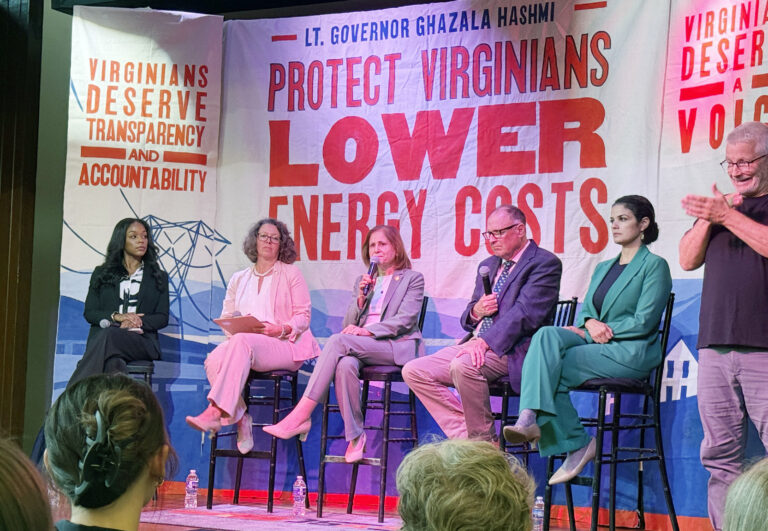
Louisa District Supervisor Manning Woodward appeared on a roundtable discussion with Central Virginian elected officials on “Real Talk with Keith Smith” last Friday, sharing information about how the county is navigating data center development as well as hinting at a future reservoir to accompany the Northeast Creek Reservoir.
Woodward, whose family goes back six generations in the county, documented some history of Louisa, noting that the county roughly stayed the same up until the 1960’s. When Virginia Electric and Power Company’s (VEPCo), which now operates primarily as a subsidiary of Dominion Energy, approached the county about building a nuclear power plant, that is what really advanced Louisa County, Woodward said.
He noted the population explosion as a result of the construction phase as more and more people started staying in the county and then sending their kids to the Louisa County Public Schools (LCPS) system. What that development brought was more than just employment, but tax dollars to the county, Woodward said, noting that without that income Louisa would be in a tough financial situation.
“You guys really jumped into these big picture items and made a big impact on the county,” host Keith Smith said, talking about the power station as well as the effort to supply water to Zion Crossroads.
The conversation shifted toward data centers and the amount of revenue they are anticipating to generate. Starting Fiscal Year 2027, Louisa County will reduce the personal property tax by 15% with a goal in the next five years to not have that tax in Louisa, almost completely as a result of data center development, Woodward said.
Louisa County has two Amazon Web Services (AWS) data centers, the roughly 150-acre Lake Anna Technology Campus east of the intersection of Haley Drive and Kentucky Springs Road and the North Creek Technology Campus situated on a 1,444-acre tract across from the Northeast Creek Reservoir.
Woodward stated one of the ways that Louisa can benefit from the revenue generated by data centers is through road projects with the Virginia Department of Transportation (VDOT). The panel talked about VDOT’s SMART SCALE program, which is Virginia’s approach to allocating tax dollars for transportation projects. Funding is appropriated in a two-year cycle and Woodward noted the money is not available for rural areas as money is going to Northern Virginia as opposed to the Culpeper District, which Louisa is in.
In the program, localities can leverage their own funds to cover a portion of the project, which Woodward believes will help with progress in Louisa County.
“To me, I see this as probably the only hope that Louisa County has to be able to make any major traffic improvements… we don’t have the money right now to go out and fund these projects,” Woodward said.
With the tax revenue from data center development, the county is less reliant on housing growth, Woodward said, which the county is actively trying to cut down on.
Also discussed with data centers were the positives of tax revenue contrasted with the negatives like water usage, light pollution, and lack of job creation.
Water is “absolutely a concern,” but Woodward stated that Amazon is making improvements to their efficiency. Amazon recently issued a press release that their data centers are seven times more water-efficient than the industry average as air cooling is used for the majority of the year while water is used only during the hottest days.
The Northeast Creek Reservoir, which has a daily safe yield of 3.2 million gallons, is where the water for the data centers is going to be drawn from. Earlier this month in June, the Louisa County Water Authority (LCWA) announced that Zion Crossroads and Lake Anna customers were under mandatory water restrictions due to the decline in water supply and limited precipitation in the forecast. The restriction did not apply to the Northeast Creek Reservoir.
“[The Northeast Creek Reservoir] has remained in good shape,” Woodward said. “It’s been a test on what the predictions have been and what we can do —- but [water usage of data centers] is a concern. We are in discussions — I won’t say that there are advanced discussions at this stage— in realizing that even without the data center situation, it is not good to just have one water source for the central part of the county. Somewhere along the line [within ten years]…we’re probably going to wind up building another reservoir somewhere.”
Woodward said one of the technologies that’s changed over the past several years is how data centers use water; for AWS campuses, outside air cooling is planned to be used 96% of the time where water use is not required. During the hottest hours of the year, evaporative cooling is used where a large fan draws warm air through pads made of absorbent material; when the hot air interacts with the water, heat causes the water to evaporate. That cool air is then blown into server rooms to prevent IT equipment from overheating.
The Lake Anna Technology Campus has one of its seven buildings complete, with the second likely to be online in August, Woodward said. 10 data center campuses are planned for the North Creek Technology Campus.
Woodward also mentioned EdgeCore Digital Infrastructure, the third data center in Louisa County located at the Shannon Hill Regional Business Park, and how they have a different way to cool their data center.
EdgeCore will use a closed-loop system to cool their data centers, a sealed system where coolant circulates past hot servers and travels to a chiller; the coolant, which could be water or dielectric fluid, recirculates continuously in a sealed loop.
Woodward also stated that EdgeCore will provide their own power “behind the meter” and that while it may not be a gas plant with stacks, it could be a smaller gas plant or even a Small Modular Reactor (SMR). He reiterated that the county has not seen any plans yet for EdgeCore, but that they avoid the two main complaints about data centers from rural residents — impact on the power grid with massive load demands and impact on water usage.